


The Leadership Ceiling
Every business hits a ceiling. Some hit it early. Some hit it later. But eventually, every owner runs into the same moment:
Everything still runs through you.
It doesn’t matter how many people you hire or how many tools you add — the work keeps finding its way back to your desk.
And here’s the truth most owners don’t want to say out loud:
They don’t have a workload problem. They have a leadership structure problem.
The Problem
Most owners don’t get stuck because they’re unwilling to delegate. They get stuck because of one word:
Trust.
It only takes one bad estimate, one bad hire, one job to go sideways and suddenly, you’re back in the middle of everything.
Not because you want control, but because you don’t trust the structure enough to stay out of it.
When trust drops, structure collapses. When the structure collapses, training becomes reactive. When training is reactive, the owner becomes the safety net for every decision.
That’s the leadership ceiling. The point where the business can’t grow any further because the owner is still the central processor.
The Story
In the early days of Crimtech, I remember sitting in the office watching the same pattern repeat itself.
- A welder would walk in with a question.
- Then someone from drafting.
- Then one of the estimators.
- Then a department manager.
Every decision — big or small — came to me.
Not because I wanted it that way, but because the structure wasn’t strong enough to support them.
I’ve seen the same thing in other businesses, too.
Shop or field Techs keep picking the wrong parts for jobs. Not because they were careless but because the process was unclear.
Unclear processes always roll uphill.
Or the time someone tried to fix an issue in the inventory system and accidentally created more problems.
Not because they were incompetent. Because no one had ever trained them on how the program actually worked.
Or the planning meetings where everyone agreed on the problem… but no one owned it. That one employee who became the “trash can”. Everything got thrown at them simply because they put their hand up.
These aren’t people problems.
These are structural problems.
And they all come back to the same three roots:
Lack of trust.
Lack of structure.
Lack of training.
The Lesson
A business can only grow to the level of trust that resides within it.
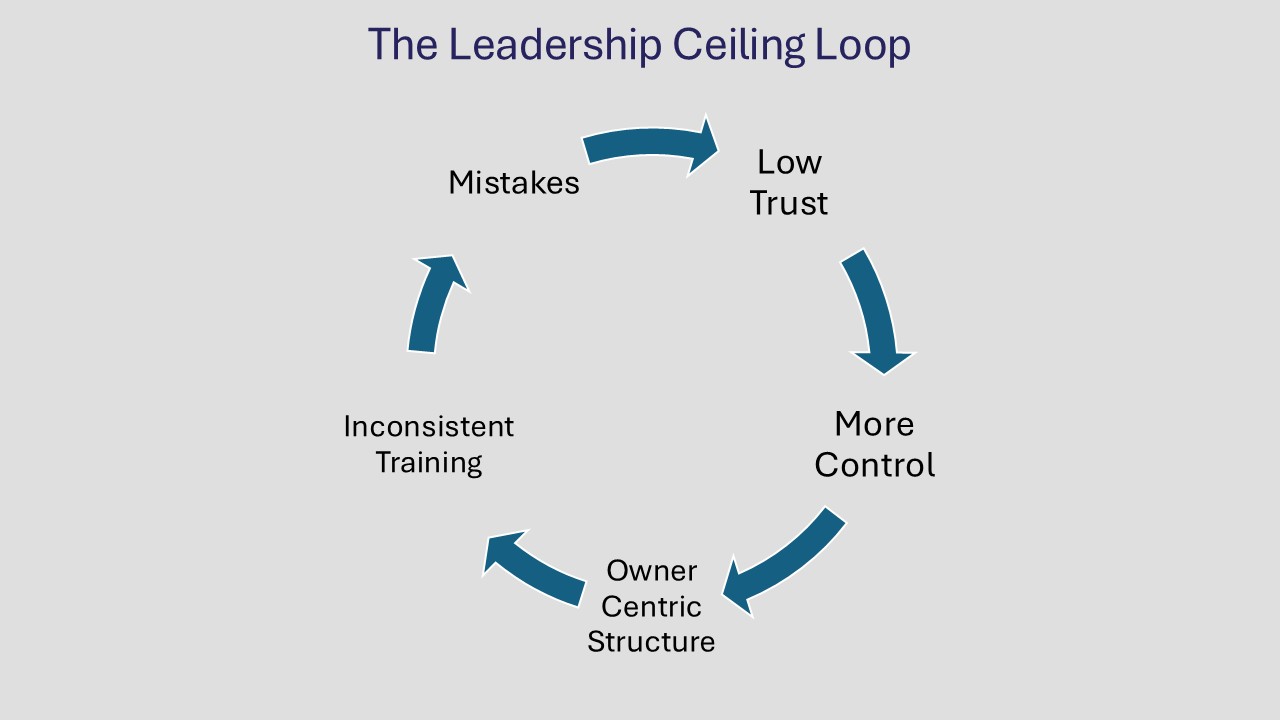
- When trust is low, leaders compensate with control.
- When leaders compensate with control, structure becomes owner‑centric.
- When structure becomes owner‑centric, training becomes inconsistent.
- And when training is inconsistent, mistakes happen.
- And when mistakes happen, trust drops even further.
It’s a loop. A predictable one. A painful one. And one that shows up in every business that’s outgrown its early stage but hasn’t yet built the structure for the next one.
The leadership ceiling isn’t about how hard you work. It’s about how much your business depends on you to function.
If everything still runs through you, your business can’t scale.
And you only have so much time in the day.
The ceiling isn’t the business. The ceiling is the structure around the business.
When you fix the structure, trust grows. When trust grows, training sticks. When training sticks, people take ownership. And when people take ownership, the ceiling breaks.
What You Can Do Tomorrow
Here are a few simple, practical steps to start breaking your leadership ceiling:
1. Write down tasks you currently do that someone else could do.
This list is always longer than you expect.
2. Identify the tasks that only you should do.
This list is always shorter than you expect.
3. Choose one recurring decision you make and document the criteria.
If you can explain how you decide, someone else can eventually decide.
4. Pick one process that causes repeated mistakes and fix the structure, not the person.
Write down the steps in simple bullet point format.
5. Train one person on one thing this week.
Not a course. Not a workshop. Just one skill, one process, one responsibility.
Small steps break the leadership ceiling.
People don’t fail in isolation — they fail inside systems.
If you want help identifying your leadership ceiling or building the structure to break through it, I’m always open to a conversation.
Get in Touch
Ready to Talk It Through?
You don't need a fully formed idea. If something here resonated, or if you're just starting to think about what needs to change, reach out.