


Remember the Early Days
Do you ever catch yourself thinking back to when you first started?
Maybe it was your basement. The kitchen table. A garage. Maybe it was out of your truck, piecing things together with whatever you had.
I started my first company, Crimtech, in the basement of my house.
My first job was for Imperial Oil, creating as-built drawings for their facilities. I spent my days walking sites, tracing pipes, connecting systems, and making field notes. At night, those notes had to become real drawings—but I wasn’t a draftsman.
So I hired one.
That meant buying a computer, AutoCAD, a printer… and turning a bedroom into an office.
That’s how it started.
Within three months, we moved into a small office in Red Deer. We hired more people. My wife taught herself bookkeeping and worked nights after we put our first child to bed.
It was chaotic. It was exhausting. And it was exciting.
In the first year, we crossed $100,000 in revenue.
“This is actually working.”

When Growth Starts to Feel Heavy
As the business grew, things changed. We added staff. We added customers. We added complexity.
And then came the moment every business owner knows—but few talk about:
Payroll.
Every two weeks, like clockwork. Followed closely by its two-faced cousin: cash flow.
I would sit in meetings, look around the room, and think:
“I’m responsible for all of this.”
Mortgages. Rent. Families. That pressure doesn’t show up in business books.
The $1.5M Revenue Trap
Most businesses grow quickly to about $1M–$2M in revenue.
And then… they stall.
Not because of lack of demand. Not because the owner isn’t working hard enough. But because the business hits a ceiling and needs help identifying what’s really holding it back.
You feel it when:
- You’re busy, but growth has slowed
- Cash is tight, even with solid revenue
- You can’t hire enough—but can’t afford to hire wrong
- You don’t have time to step back and think
- Everything still depends on you
It feels like progress… but also like pressure. That’s the trap.
The 4 Ceilings That Hold You Back
Most businesses at this stage aren’t broken. They’re just constrained. From my experience, those constraints usually fall into four areas:
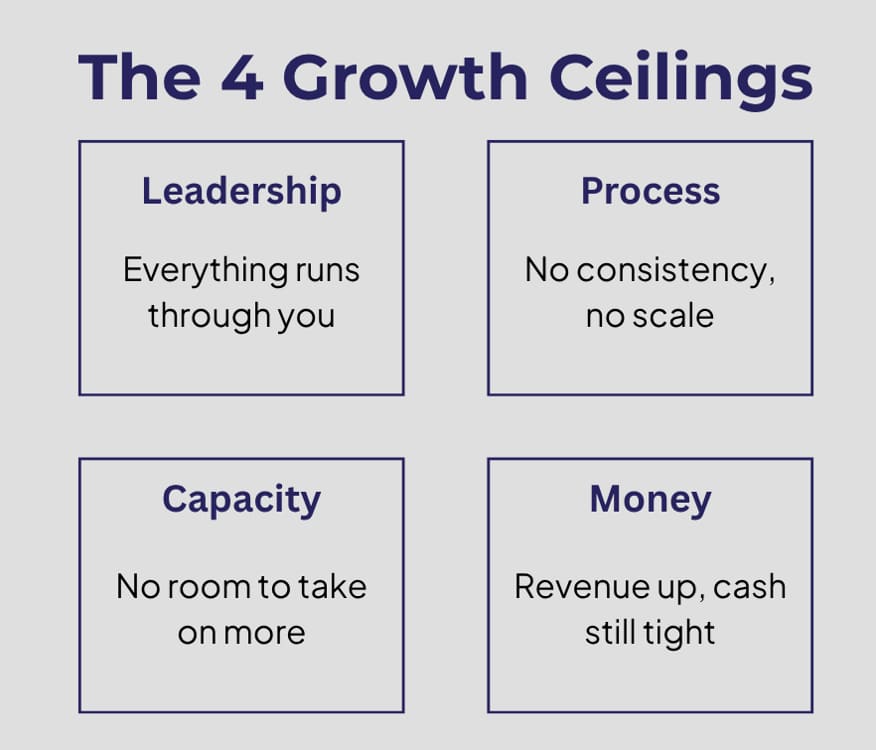
1. The Founder / Leadership Ceiling
The business can’t grow because the owner hasn’t shifted from doing the work to leading the business. Delegation is inconsistent. Decisions bottleneck at the top. Everything still runs through you.
2. The Operations / Process Ceiling
There are no clear, documented processes. Work gets done—but not consistently. Quality varies. Training is reactive. And scaling becomes almost impossible.
3. The Space / Resource Ceiling
Sometimes growth hits physical limits. Not enough space. Not enough people. Not enough capacity to take on more work—even if demand is there.
4. The Revenue / Money Ceiling
This one is less obvious. At some level, many owners develop a comfort zone around revenue and income. They hesitate to invest. They delay decisions. They unknowingly cap their own growth.
Looking Back
At Crimtech, I didn’t know these ceilings existed. But I was hitting them. We didn’t have structured sales. We didn’t have documented processes. And I was still doing too much myself.
I thought I needed more customers. What I actually needed was a better structure.
The Real Problem
Most business owners think they have a sales problem. In reality, they have a structure problem—the kind of issue strategic mentorship is built to work through.
Because:
Revenue can grow faster than structure.
And when it does, the business feels heavier instead of better.
The Way Forward
The $1.5M mark isn’t a failure point. It’s a transition point.
From:
- Doing → Leading
- Reacting → Building systems
- Being busy → Being intentional
The businesses that break through this stage don’t just work harder. They change how the business operates.
Final Thought
If you feel stuck at this stage, you’re not alone. And you’re not broken. You’re just at a point where the business needs to evolve.
The question is:
Will you make that shift… or stay stuck in the trap?
If this feels familiar, you’re likely not facing a growth problem—you’re facing a structural one.
I work with business owners at this exact stage to help them step back, identify what’s really holding the business back, and put the right structure in place to move forward.
If you’d like to talk it through, reach out. We’ll start with a simple conversation.
Get in Touch
Ready to Talk It Through?
You don't need a fully formed idea. If something here resonated, or if you're just starting to think about what needs to change, reach out.